
Issaquena County Court Records After Arrest
In Issaquena County, an arrest is the custody event. The court record is the filed case that follows it. A deputy, officer, or warrant authority may start the custody side, but the District Attorney or other prosecutor decides what formal charge moves forward. Issaquena County is in Mississippi Circuit Court District 9 with Sharkey and Warren counties. The official district map identifies District Attorney Ricky Smith for District 9, and the Secretary of State directory lists him as Richard Ricky Smith Jr. at P.O. Box 648, Vicksburg, MS 39181, phone 601-636-5754.
The booking side and the court side should not be treated as the same record. For jail custody, use Issaquena County jail inmate records and the facility or sheriff contact path. For booking photos, use Issaquena County jail mugshots. Court records after a jail arrest are about complaints, indictments, bond orders, warrants, charge status, pleas, dismissals, and final dispositions.
Find Issaquena County Court Records
Mississippi uses MEC and PAMEC for public electronic court access, but the research found that online access requires registration, subscription, or login. Direct inspection was limited by server and maintenance errors, so a public user should not assume a free, open case search will show every document. For Issaquena County court records after arrest, the more reliable starting points are the appropriate clerk and the known case details: full name, date of birth, arrest date, charge, case number if known, and the court level.
- Check whether the matter is likely a Justice Court issue, a Circuit Court criminal filing, or an early warrant or bond question.
- Use MEC/PAMEC only if registration and login access are available for the court record needed.
- Call Circuit Clerk Ronda Delaney for circuit criminal filings at 662-873-2761, or write to P.O. Box 27, Mayersville, MS 39113.
- Call Justice Court Clerk Katelynn Carpenter for justice-court warrants, lower-court matters, or preliminary issues at 662-873-6287, or write to P.O. Box 58, Mayersville, MS 39113.
- Ask for the filed court charge and current status, not just the arrest charge shown at booking.
The clerk path matters because Issaquena County does not publish a complete official online court-record inventory through the sheriff page. Public access exists through court systems and public-record law, but the record holder controls inspection, copying, and any redaction. Names, dates, and case numbers keep the request specific enough for the office to search.
Arrest Charges and Court Filings
A jail arrest may begin with a booking charge. That does not mean the same charge will remain in court. Prosecutor review can lead to an amended charge, a reduced charge, a dismissal, an information, or a grand-jury indictment. The court record after an Issaquena County arrest should be read as the filed case history, not as a mere copy of the jail intake entry.
| Document | Who Usually Initiates It | What It Means |
|---|---|---|
| Complaint or affidavit | Officer, prosecutor, or complainant under court procedure | Starts a lower-court or early criminal charge path after arrest. |
| Information | Prosecutor | A formal prosecutor-filed charge where permitted. |
| Indictment | Grand jury | A grand-jury charging document, most often tied to felony prosecution. |
For felony prosecution, the District Attorney for Circuit Court District 9 is the office tied to the charge decision. County-level prosecution matters may involve County Prosecuting Attorney Charles Weissinger, listed in the Secretary of State directory at P.O. Box 215, Rolling Fork, MS 39159, phone 662-873-6258. Clerk staff can identify where the filed record sits, but they do not replace legal advice.
Issaquena County Charge Status
Charge status is one of the main reasons to search court records after a jail arrest. A roster or jail call may confirm custody, while the court file tells whether the accusation is pending, amended, dismissed, retired, or resolved. Mississippi court terminology can vary by docket, so the safest method is to ask the clerk what the current status means in that specific case.
| Status | Plain Meaning | Why It Matters |
|---|---|---|
| Pending | The charge remains open. | Future court dates, bond terms, or plea settings may still apply. |
| Amended or reduced | The filed charge changed after review. | The court record may differ from the jail booking charge. |
| Dismissed | The charge was ended by court action. | Dismissal does not always remove the arrest record from public access. |
| Nolle prosequi | The prosecutor declines to proceed on that charge. | The case may close, but record access depends on court handling and expunction rules. |
| Remanded | The matter is sent to a lower court or different track. | The record may need to be checked in more than one court office. |
Bond After Issaquena County Arrest
Bond and court records meet at the first appearance and later hearings. Issaquena-specific online bond payment rules, payment types, hours, and fee schedules were not published in the official sources reviewed. Anyone trying to post bond should call the facility, the sheriff, and the correct clerk before travel. The key local numbers are the Issaquena County Correctional Facility at 662-873-2153, the sheriff at 662-873-2781, Justice Court at 662-873-6287, and Circuit Clerk Ronda Delaney at 662-873-2761.
| Bond Term | Meaning |
|---|---|
| Cash bond | The full amount is posted in cash or an approved payment form. |
| Surety bond | A licensed bonding company posts the bond for a fee and promise to ensure court appearance. |
| Own recognizance or PR | Release is based on a promise to return without posting the full cash amount. |
| No-bond hold | Release is not available until a judge or the holding agency changes the status. |
| Detainer or hold | Another county, MDOC, federal authority, probation, parole, or ICE may block release. |
A bond amount on one charge does not guarantee release. A second warrant, a probation hold, an MDOC hold, a U.S. Marshals hold, or an ICE detainer can keep the person in custody after the local bond issue is resolved. That is why the court record, jail custody record, and outside-agency hold status must be checked together.
Warrants After an Issaquena Arrest
No official Issaquena County active warrant search or most-wanted list was located in the sources reviewed. A lack of web results is not proof that no warrant exists. Warrant questions should go to the office that can see the warrant or case file: the sheriff for law-enforcement warrant questions, Justice Court for justice-court warrants, and Circuit Court for capias or circuit-case warrant issues.
Common warrant terms include arrest warrant, bench warrant, search warrant, fugitive warrant, capias, probation warrant, parole warrant, and out-of-county hold. A bench warrant is commonly tied to failure to appear or violation of a court order. A capias is a court command to take a person into custody. These records can lead to a new jail arrest or affect release on an existing case.
Charges Versus Convictions
Court records after a jail arrest must be read with care because a charge is an accusation. It is not a finding of guilt. A conviction occurs only after a guilty plea, verdict, or other court outcome that legally resolves the charge as a conviction. This distinction is vital when reading an Issaquena County court record, a jail record, or any background-type search result.
| Point | Charge | Conviction |
|---|---|---|
| Stage | Accusation filed after arrest or review. | Final result after plea, trial, or court finding. |
| Proof | Can start with probable cause or prosecutor filing. | Requires proof beyond a reasonable doubt or a valid plea. |
| Record effect | May appear in court and custody records. | May affect sentence, supervision, and future record searches. |
Sealed and Expunged Records
Mississippi expunction law, including Miss. Code Ann. Section 99-19-71, controls when eligible arrest and case records may be cleared from public access. Eligibility depends on the charge, outcome, prior record, waiting period, and court order. A dismissal or nolle prosequi entry does not automatically erase every public trace of the arrest. A person seeking expunction should confirm the exact case status with the clerk and consider legal advice.
| Record Treatment | What It Does | Limits |
|---|---|---|
| Sealed | Restricts public view of the court record. | Some agencies or courts may retain limited access. |
| Expunged | Removes eligible records from public access under a court order. | Only available when Mississippi law allows it. |
| Nonpublic or exempt | Withheld because a statute, court order, juvenile rule, or investigation limit applies. | The record may still exist even if the public cannot inspect it. |
Public Access to Court Records
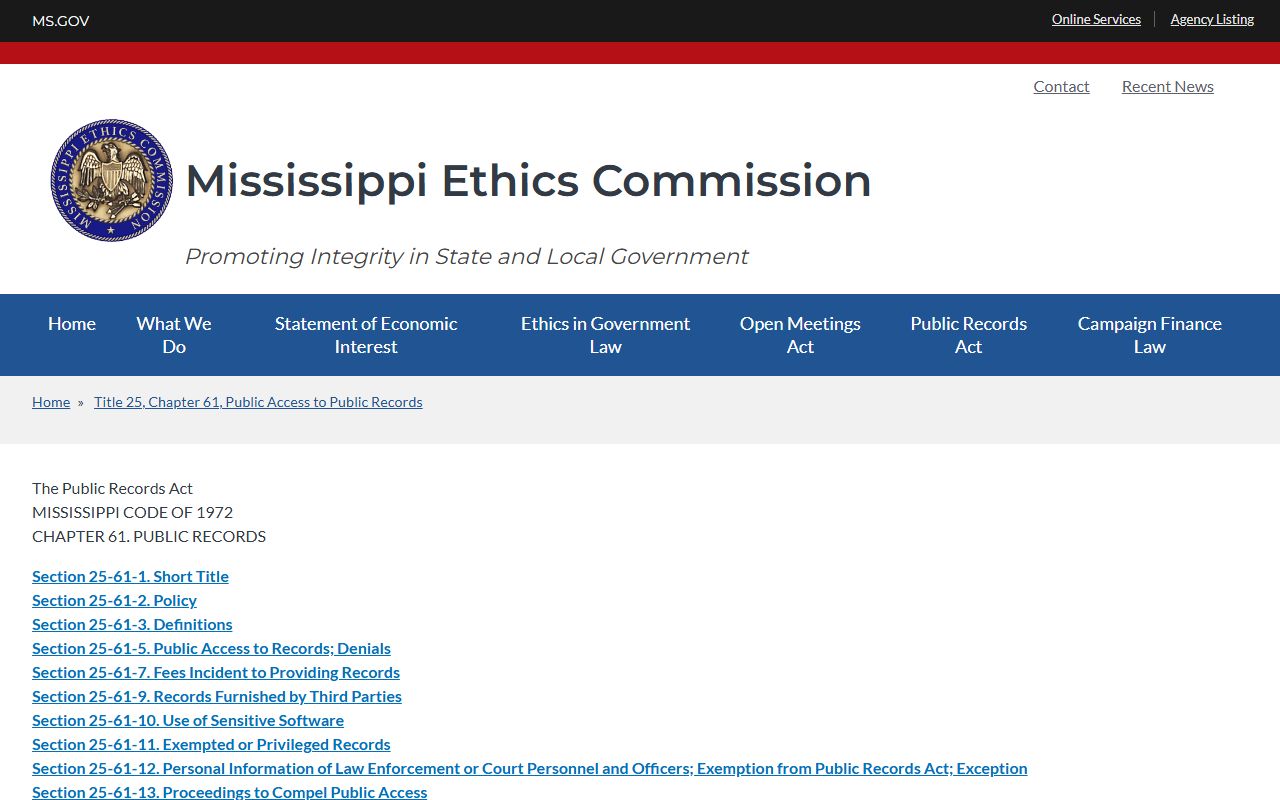
Mississippi's Public Records Act of 1983, Miss. Code Ann. Title 25, Chapter 61, supports inspection of nonexempt public records. The Mississippi Ethics Commission explains that public records must be available for inspection unless an exemption applies and that public bodies have a duty to provide access. That does not mean every Issaquena County court record after arrest is online or instantly available.
The Mississippi Ethics Commission Public Records Act page is a useful statewide source for the inspection rule. The image below comes from that source.
The practical effect for Issaquena County is simple: identify the record holder first, then ask for a specific record. Clerk offices handle court filings, the sheriff or facility handles local custody records, and MDOC handles state correctional records. Juvenile records, sealed matters, ongoing investigations, medical details, and security-sensitive information may be withheld or redacted.
Restricted Court Records After Arrest
Some records tied to a jail arrest can be public in part and restricted in part. Juvenile matters, sealed charges, expunged cases, victim data, medical details, certain investigative records, and security information may not be released. A court docket can show that a case exists while withholding a document or limiting details. The clerk can explain access procedures, but a judge or statute may control the release decision.
Important: This resource is not a consumer reporting agency, and records found here are not for credit, employment, insurance, housing, or other FCRA-covered decisions.